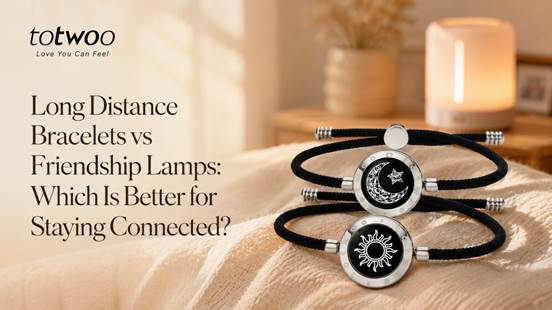
Long distance bracelets and friendship lamps are based on the same emotional idea: one person sends a small signal to let someone far away know they are thinking of them.
The difference is where that signal becomes part of everyday life.
A friendship lamp creates a visible, ambient reminder inside the home. A bracelet turns the interaction into something wearable that can follow the recipient through work, school, commuting, and travel.
Neither option is universally better. The right choice depends on where the recipient spends time, whether they enjoy wearing jewelry, how private the signal should be, and how much setup or maintenance they are comfortable managing.
Long Distance Bracelets vs Friendship Lamps at a Glance
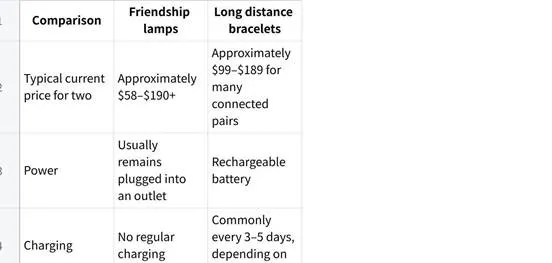
点击图片可查看完整电子表格
Prices and features change by brand and model. Buyers should always confirm whether the displayed price is for one item or a complete pair.
How Friendship Lamps Create Connection
Friendship lamps usually connect through Wi-Fi. When one person touches a lamp, the linked lamp changes color or begins to glow.
The signal is intentionally simple. It does not contain a full message, but the people using the lamps can give different colors their own meanings.
A warm yellow might mean “good morning.” Blue could mean “I miss you,” while green might mean “I arrived home safely.”
Friendship Lamps Work Well as Home Décor
One of the biggest advantages of a friendship lamp is that it remains visible even when nobody is actively using it.
It can sit on a bedside table, desk, bookshelf, or living-room cabinet and function as part of the décor. When it lights up, the signal changes the atmosphere of the room rather than appearing as another phone notification.
This can feel especially comforting for parents, grandparents, adult children, or close friends who live apart.
They Can Connect More Than Two People
Some friendship-lamp systems allow multiple lamps to join the same group. When one person touches a lamp, every lamp in that group can display the chosen color.
This makes lamps particularly suitable for families. Parents, siblings, grandparents, and adult children living in different homes may all participate without limiting the experience to a single couple.
Group compatibility varies, so buyers should check how many lamps can be connected and whether different lamp designs work together.
They Do Not Need to Be Worn or Recharged
Most friendship lamps remain connected to an electrical outlet. This means the recipient does not have to remember to wear or recharge anything.
That may be a significant advantage for someone who does not wear jewelry, frequently forgets to charge devices, or finds small wearable controls difficult to use.
After the initial setup, interacting with the lamp may be as simple as touching its surface.
The Limitations of Friendship Lamps
The main limitation is location. A lamp can only be noticed when the recipient is in or near the room where it is placed.
If the person is working, commuting, shopping, traveling, or attending classes, the signal may not be seen until later. This makes friendship lamps less immediate for people who spend much of the day away from home.
Most connected lamps also require stable home Wi-Fi. Some models specifically use a 2.4 GHz network, which may require additional setup on routers that combine 2.4 GHz and 5 GHz connections.
Buyers should also check for ongoing costs. Many traditional friendship lamps do not require subscriptions, but some lower-priced models charge a monthly or annual fee for remote-touch functions. A less expensive initial price may therefore create a higher long-term ownership cost.
How Long Distance Bracelets Create Connection
Connected long distance bracelets are designed to carry the signal beyond the home.
Depending on the model, touching one bracelet can trigger a light, vibration, or combined response on the partner’s wrist.
That physical contact can feel more immediate than a lamp changing color across a room. A vibration may arrive before an important meeting, during a commute, or at the end of a late shift.
Bracelets Are Portable
Portability is the clearest advantage of bracelets.
The interaction can travel with the wearer to work, college, the airport, or another country. As long as the bracelet remains charged and connected, the signal is not limited to one room.
The bracelet also remains a visible symbol of the relationship when no signal is being sent.
The Interaction Can Be More Private
A friendship lamp is designed to be seen. Roommates, relatives, coworkers, or visitors may notice when it changes color.
A bracelet response is usually more discreet. A short vibration may only be noticed by the person wearing it, allowing couples to develop signals that feel like a private language.
This privacy may be useful for couples who want to interact without creating another visible phone notification.
Bracelets Require More Daily Maintenance
The portability of a bracelet comes with additional responsibilities.
Both partners may need to:
• Wear the bracelets regularly
• Recharge them every few days
• Keep Bluetooth enabled
• Maintain phone and internet connections
• Allow the companion app to operate in the background
• Reconnect the bracelet after changing or restarting a phone
If one partner does not normally wear bracelets or frequently forgets to charge devices, the connected experience may become inconsistent.
Comparing Price and Long-Term Cost
The initial prices of friendship lamps and connected bracelets can overlap.
Representative friendship-lamp pairs currently range from about $58 for a subscription-based set to approximately $140-$189 for selected non-subscription designs. Lower upfront pricing should be compared with any required monthly or annual service fees.
Connected bracelet pairs commonly fall between approximately $99 and $189, although materials and features can move prices outside that range.
Selected Totwoo bracelet models list approximately three to five days of battery life and about one hour of charging time. Current product information also states that there is no monthly account fee for selected models.
The better value depends on more than the purchase price. A lamp needs a permanent space, outlet, and compatible Wi-Fi connection. A bracelet needs regular charging, phone access, Bluetooth, and a willingness to wear it.
Which Is Better for Couples?
Long distance bracelets may be more suitable when both partners:
• Regularly commute, work, study, or travel
• Want to receive signals outside the home
• Enjoy wearing bracelets or smart jewelry
• Prefer private vibration or light responses
• Are comfortable managing an app and Bluetooth connection
Friendship lamps may be more suitable when both partners spend considerable time at home and prefer an ambient visual signal.
The lamp may also be the stronger choice when one partner dislikes jewelry, has difficulty wearing something on the wrist, or does not want another rechargeable device.
Which Is Better for Families and Older Relatives?
Friendship lamps often have a clearer advantage for families.
They can be easier to notice in the home, do not need to be worn, and may allow several relatives to participate in the same connected group. This makes them relevant to parents, grandparents, siblings, and adult children living in different locations.
However, initial Wi-Fi and app setup may still require assistance. For an older recipient, it may be helpful to configure and test the lamp before giving it as a gift.
Bracelets may work for family members who already enjoy wearable technology, but their smaller controls, charging requirements, and phone permissions can create more maintenance.
Choosing Based on Daily Routine
Choose a friendship lamp if:
• The recipient spends much of the day at home
• You want an ambient home-based signal
• The gift is for parents, grandparents, friends, or a family group
• The recipient does not like wearing jewelry
• You want to avoid charging another portable device
• A visible signal is part of the appeal
Choose a long distance bracelet if:
• Both people want interaction throughout the day
• They frequently commute, study, work, or travel
• They want a signal that can be felt privately
• Both people already wear bracelets or smart accessories
• They are comfortable charging the device regularly
• They can maintain the necessary phone, app, and internet connections
The Better Choice Depends on Where Connection Happens
Friendship lamps are not simply less portable versions of connected bracelets. They offer a different experience: visible, ambient, home-based, and potentially suitable for an entire family.
Long distance bracelets provide a more mobile and private experience, but they require both people to wear, charge, and connect them consistently.
If connection mainly happens at home, a friendship lamp may become the more natural ritual. If connection needs to follow both people through workdays, classes, commutes, and trips, a bracelet may fit better.
The best choice is the one that becomes part of the recipient’s real routine instead of another connected gift that is eventually left unused.